
From Design Futures to Embodied Perception Lab
Research Archive — Summer 2026
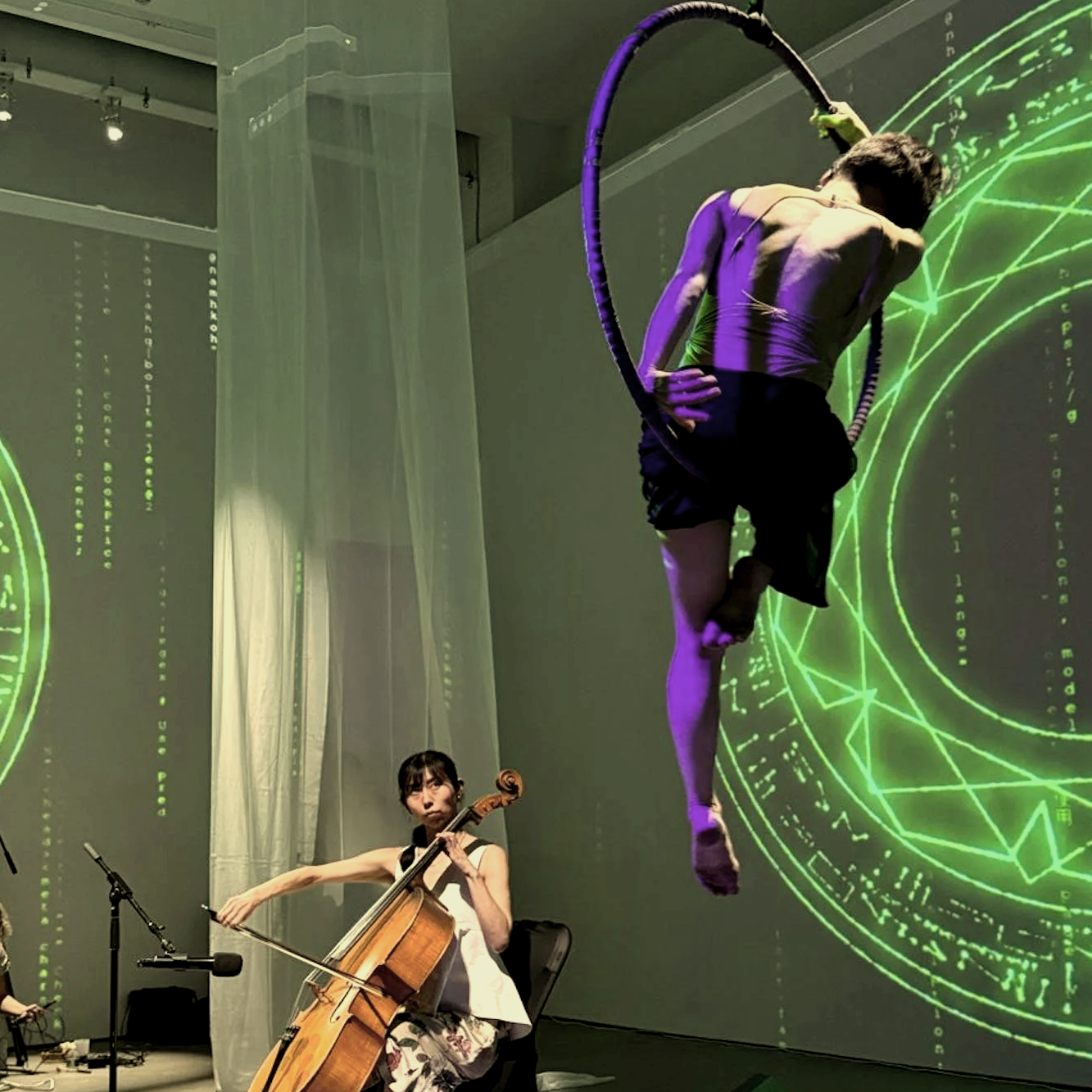
What kinds of experiences allow us to remain capable of questioning, making meaning, and choosing how we want to live?
This research archive documents an eight-week inquiry developed through Parsons’ Design Futures 101 in Summer 2026.
Beginning with questions around technological optimization, progress, and human agency, the research gradually moved toward embodied experience:
how artistic encounters might create conditions for perception, reflection, questioning, and meaning-making.
The process eventually led to Embodied Perception Lab #01, a public research experiment in New York City combining performance, spatial experience, dialogue, and observation.
Rather than presenting a finished answer, this archive traces how the questions themselves changed through Futures Studies methods, artistic practice, and lived experimentation.
1. The Starting Question
What Do We Mean by a “Better Future”?
When I began studying Design Futures, I was interested in how AI, algorithms, efficiency, and optimization might influence human perception and choice.
When we think about the future, we often describe progress in terms of more convenient societies, more efficient systems, and more advanced technologies. Through the course, however, I began to question this assumption itself.
By what measure do we decide that a future is “better”?
AI and algorithms can process enormous amounts of information and offer us the “most likely answer” or choices supposedly optimized for us. But receiving an answer is not the same as observing, feeling, thinking, and making a judgment for ourselves.
If the future continues toward removing friction and uncertainty while providing increasingly optimized answers, what happens to the opportunities through which we recognize our own desires and values, and begin to form questions of our own?
This tension became the starting point of my research.
2. Design Futures Methods
Not Predicting the Future, but Learning How to See the Questions
In Design Futures, I encountered methods for examining change, values, and underlying assumptions from multiple perspectives—not simply for “predicting” the future.
Through Signal Scanning, I observed small changes emerging at the edges of society and began to recognize recurring tensions in my own interests: efficiency and human experience, technology and human relationships, information and embodied experience.
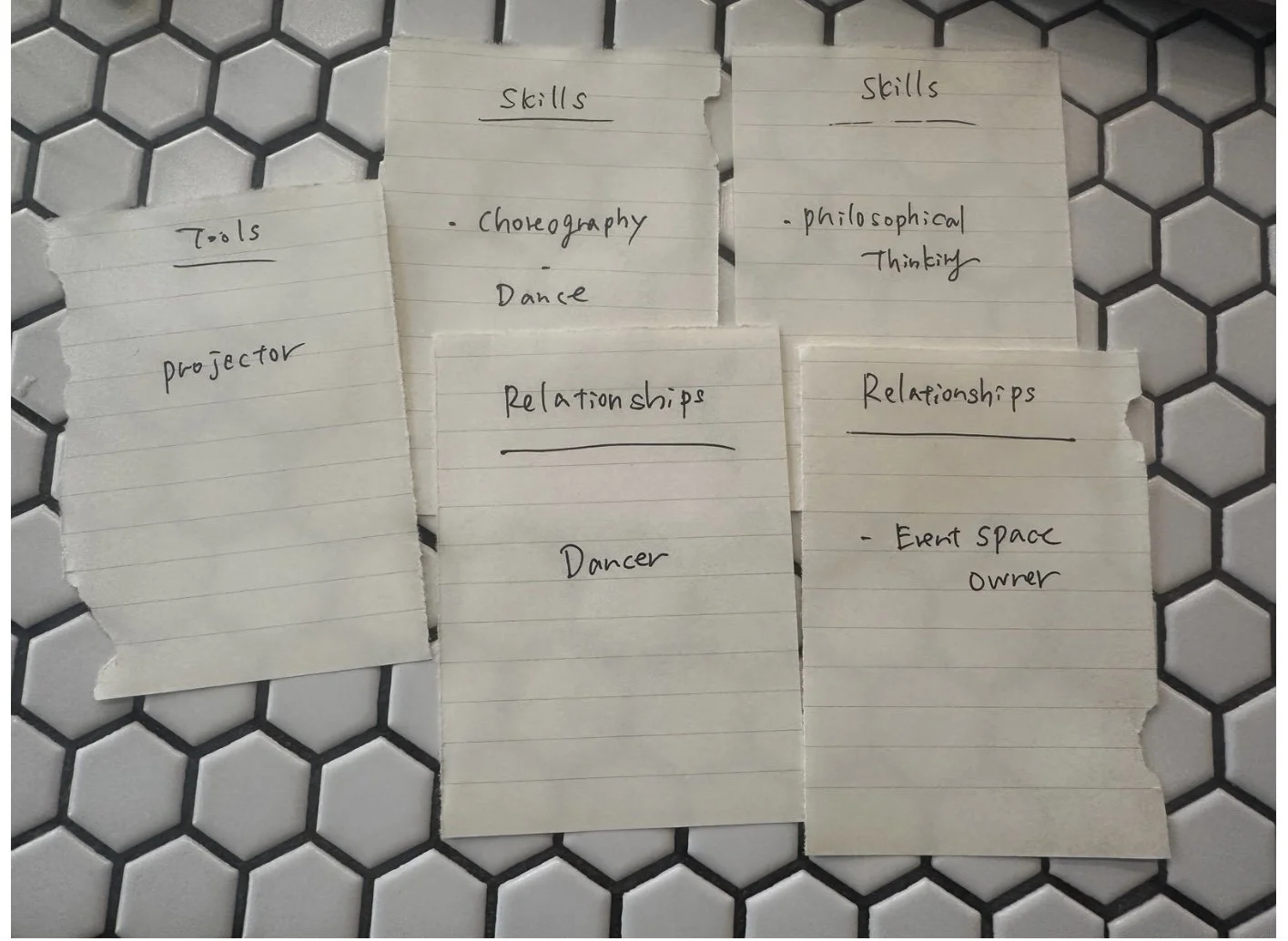
Through Asset Mapping, I explored how resources already present in my practice—movement, space, visual media, and dialogue—could be combined to transform abstract questions into situations that could be experienced through the body.
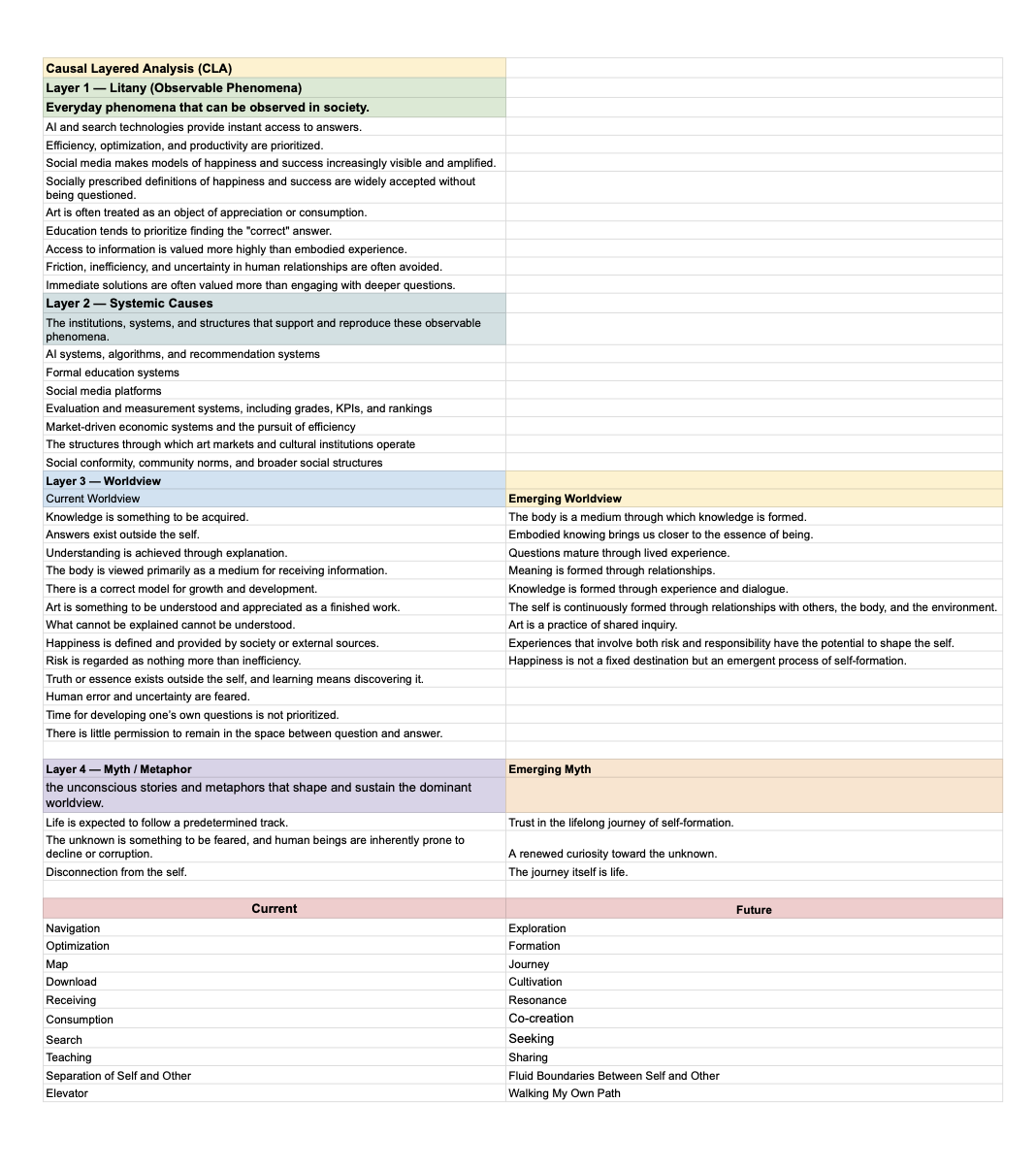
Causal Layered Analysis (CLA) helped me recognize the values and worldviews beneath visible technological change: assumptions such as “efficiency is good,” “friction should be removed,” or “the faster we receive an answer, the better.”
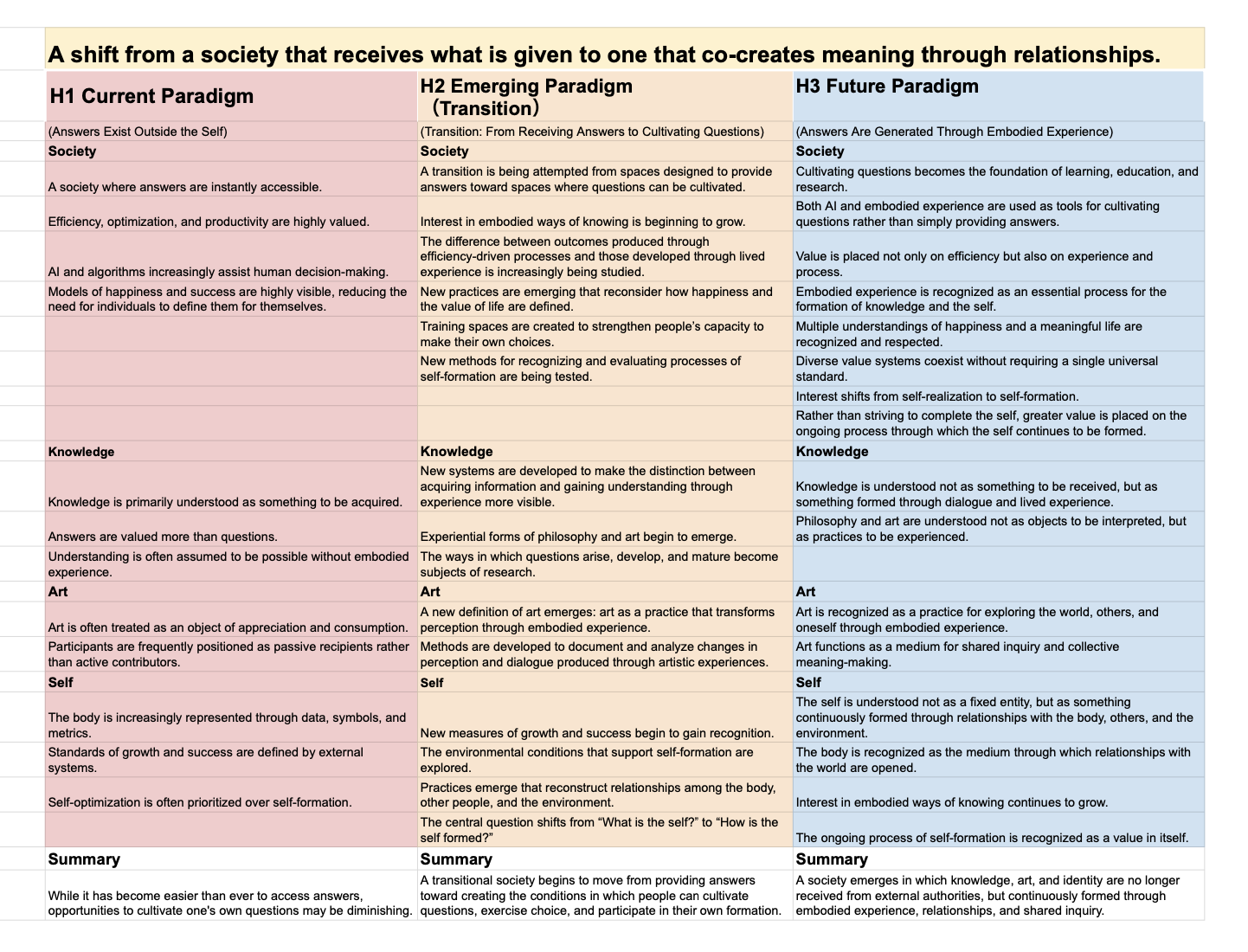
Through Three Horizons, I began to reconsider my artistic practice not as a sequence of finished works, but as an evolving field of research shaped through experimentation and transition.
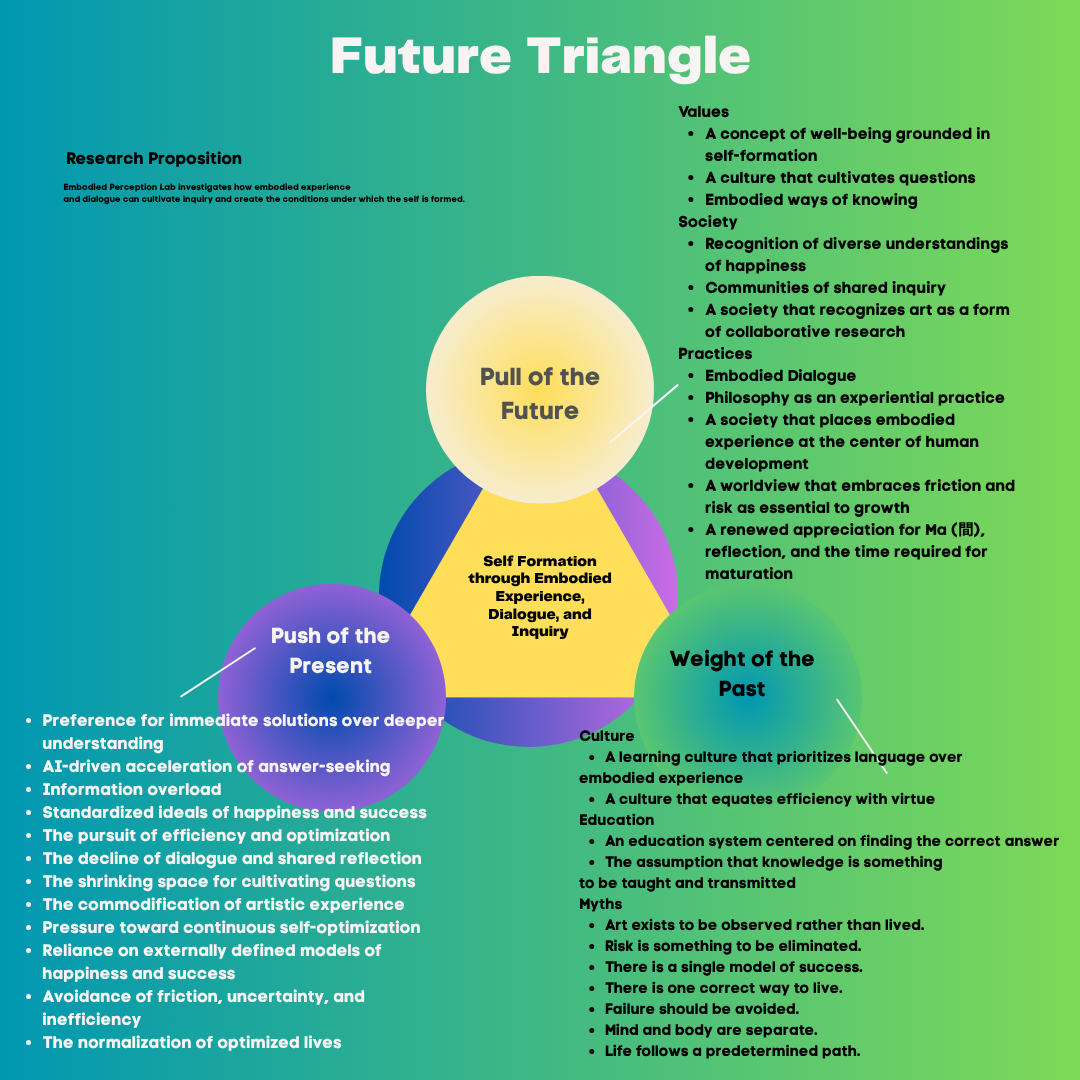
And through the Futures Triangle, I was able to examine inherited values from the past, present pressures toward optimization, and possible futures that place greater importance on human agency and embodied experience within a single framework.
These methods did not give me answers.
Instead, they became ways of discovering what I was resisting, and why I kept returning to certain questions.
3. Research Evolution
From “Designing Futures”
to the Human Beings Who Live Them
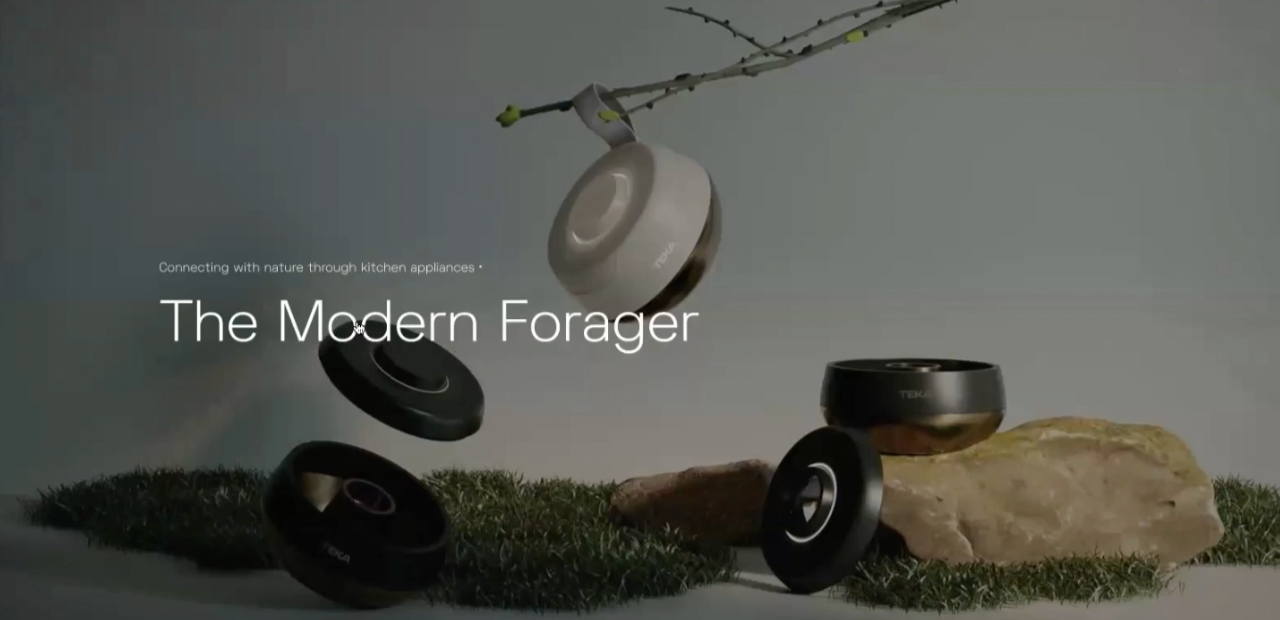
Over the eight weeks, the focus of my research gradually shifted.
I began by asking how AI and increasing optimization might affect human society and shape possible futures.
But as I studied Plural Futures and Speculative Design, another question gradually emerged:
Before asking what kind of future we should create, what happens to the human beings who will live within it?
Technological and intellectual progress does not necessarily mean that our inner development, capacity for judgment, or ability to form our own values develops alongside it.
I began to question whether technological progress and human development should be understood through the same idea of “progress.”
During the Week 3 design process, I explored the possibility of transforming philosophical questions from something explained through words into something that could be experienced through the body.
This led me to think about the difference between understanding something intellectually and encountering it through embodied experience.
From there, a hypothesis began to emerge:
Just as the body requires nourishment, perhaps our inner lives also require experiences that disturb our perception, temporarily remove us from familiar values, and allow us to form meaning for ourselves.
My question gradually shifted from:
“What kind of future should we design?”
to:
“What kinds of experiences support our capacity to perceive, question, and continue forming meaning for ourselves?”
Through this shift, art began to occupy a different position within my research—not simply as a means of expression, but as a site for investigating experiences through which people encounter the world directly and begin to form questions of their own.
4. Embodied Perception Lab #01
Testing the Question Through Experience
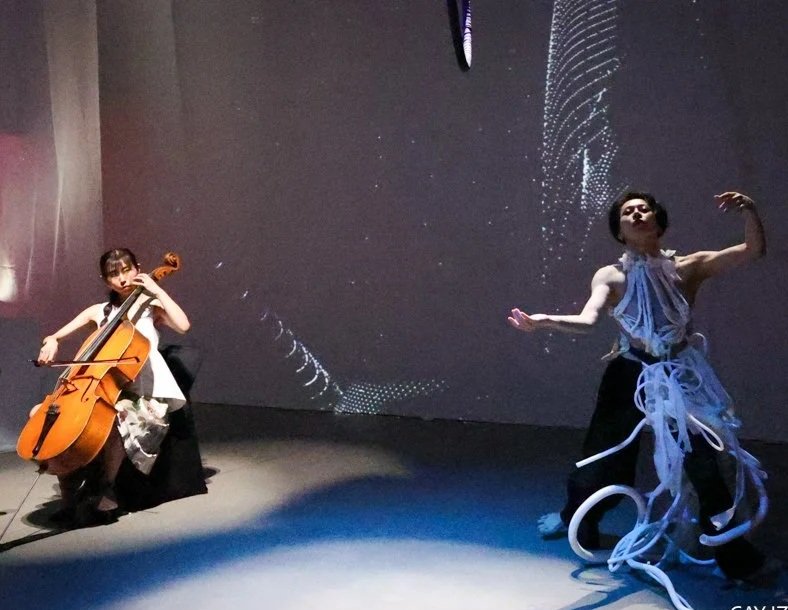
The first public experiment to emerge from this process was Embodied Perception Lab #01.
Approximately 40 participants gathered for an environment combining dance, aerial performance, music, visual projection, spatial experience, and dialogue.
The purpose was not to communicate a finished message to an audience.
Instead, I wanted to observe how embodied and sensory experiences might shift participants’ perception and emotions, and what kinds of reflection, dialogue, or questions might emerge afterward.
The experiment clarified an important challenge:
Being emotionally moved is not the same as developing a question.
A strong response to a performance does not automatically become reflection or inquiry.
This raised another question:
What is needed between an embodied or emotional experience and the emergence of a question?
At the same time, many participants remained in the space after the performance and continued discussing the work and their own experiences. During the open session, some participants shifted from observing the space to physically entering it and taking part in the experience themselves.
Audience feedback also revealed different forms of response: shifts in perception, movement from observation toward participation, and connections between the work and participants’ own lived experiences.
From these observations, the focus of the research shifted from simply asking “What kind of environment should I create?” toward investigating how the entire process might be supported:
Embodied Experience → Emotion / Perception → Reflection → Articulation → Dialogue → Question / Meaning-Making
Embodied Perception Lab therefore began to move beyond being an “artwork” and toward becoming a research environment for investigating the conditions through which questions can emerge.
5. Future Direction
How Might Artistic Experience Relate to Our Capacity to Question and Make Meaning?
Through this research, my attention has begun to move toward a larger question.
When we discuss the future, we frequently talk about developments in technology, economics, institutions, and infrastructure.
But do we think with the same seriousness about how the inner lives of the human beings inhabiting those futures are formed and developed?
The body cannot grow without nourishment.
What, then, nourishes our perception, values, imagination, capacity to question, and ability to form meaning?
Could embodied artistic experience be one source of that nourishment?
Art does not necessarily provide answers. Instead, it can bring us into contact with ambiguity, unfamiliar sensations, emotional movement, different perspectives, and questions that cannot be immediately resolved.
For this reason, I want to investigate artistic experience not simply as entertainment, leisure, or cultural enrichment, but as something that may relate to our capacity to perceive for ourselves, question, create meaning, and determine what we value and how we want to live.
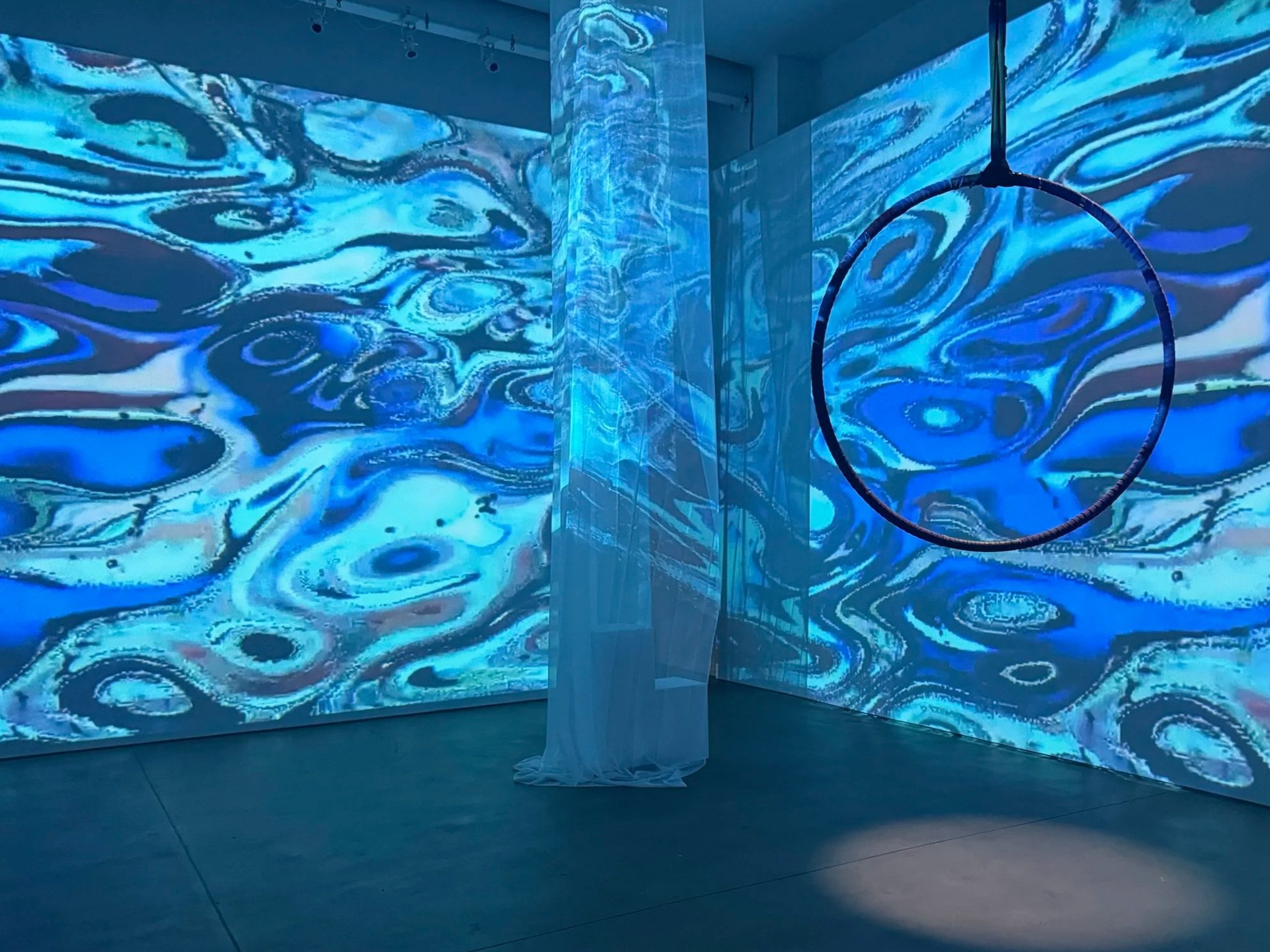
In the next Embodied Perception Lab, I will expand the research beyond performance itself to include silence, space, time, ma (間), and dialogue, designing and observing the process through which questions may emerge.
My current long-term research question is:
What role can embodied artistic experience play in sustaining our capacity to question, make meaning, and choose how we want to live?
Beyond this lies an even larger question:
If we begin to lose the experiences that allow us to question our own desires and values, how might our relationship with the future change?
Full Research Archive
Design Futures 101 / Parsons / Summer 2026
