
Aozukin: A Meditation on Desire
What is desire?
Through performing Aozukin (The Blue Hood), a story written by the eighteenth-century Japanese author Ueda Akinari, I have spent years contemplating this question.
The work follows a monk who is said to have become an oni
—a figure often translated as a demon, yet far more complex than a simple embodiment of evil.
Through this story, I have found myself observing not only desire itself, but the ways desire can transform into attachment, obsession, and ultimately madness.
Most people live their lives without ever meeting an oni.
Or perhaps they do, but choose to keep it at a distance.
Yet when we encounter overwhelming obsession, unbearable grief, or a form of madness that seems beyond comprehension—especially when we discover it within ourselves—do we possess the strength to face it?
This question lies at the heart of Aozukin.
What draws me to this story is that it is not a tale of good and evil.
Ueda Akinari does not seek to judge human desire, attachment, or madness. Instead, he continues to observe them with remarkable honesty.
He allows human weakness, contradiction, and ugliness to exist without immediately condemning them.
In this attitude, I sense a spirit deeply connected to Zen: a willingness to remain with reality as it is, rather than divide it into what should and should not exist.
Throughout the story, villagers speak of a monk who has supposedly become an oni.
Yet the narrative never confirms whether the oni truly exists.
Perhaps it was real.
Or perhaps it emerged from fear, grief, rumor, and imagination.
The story never resolves the ambiguity.
And perhaps that uncertainty is precisely the point.
Human societies often respond to what they cannot understand by giving it a name.
"Evil."
"Abnormal."
"Enemy."
Through these labels, we create our demons.
We create our oni.
But what is an oni?
Is it desire?
Attachment?
Madness?
Or is it something far more human than we would like to admit?
In the story, a devoted monk becomes consumed by the very sincerity of his spiritual pursuit.
His desire becomes attachment.
Attachment becomes obsession.
Obsession becomes madness.
And madness transforms him into an oni.
Yet the story does not end with punishment.
The monk searches desperately for salvation, only to discover that the oni is not something outside himself to be defeated.
It is already there.
And through a profound act of recognition and acceptance, the oni disappears
—or perhaps transforms. The text never tells us exactly what happens.
Its ending remains open.
Many people go through life believing that oni belong to someone else.
That madness belongs to someone else.
That obsession belongs to someone else.
Yet Aozukin suggests something far more unsettling.
The oni is not outside us.
Desire, attachment, and madness are all part of the human condition.
What is truly frightening is not the existence of desire itself.
It is our refusal to acknowledge it.
Desire is not merely the source of suffering.
It is also the source of imagination.
It is what draws us toward others.
It is what allows us to create, to seek, to love.
Desire does not turn us into oni.
Rather, when desire is denied, feared, suppressed, or left unseen, it can gradually distort itself into obsession and madness.
The tragedy of Aozukin is not desire.
The tragedy is the refusal to face it.
Desire undeniably exists within us.
The challenge is neither to suppress it nor surrender ourselves to it.
The challenge is to continue recognizing its presence.
To remain aware of it.
To allow it to exist without becoming consumed by it.
In that ongoing act of recognition, I find one of the deepest strengths of this story.
What moves me most about Aozukin is the particular sensibility it embodies.
Rather than dividing reality into simple categories, it allows contradictions to coexist.
Beauty and ugliness.
Discipline and desire.
Wisdom and madness.
Compassion and cruelty.
All can exist within the same human being.
And the story asks us not to turn away from that complexity.
There is a strength in such a posture
—a strength rooted not in purity, but in awareness.
⸻
This is also the spirit we seek to express through our performance.
Buddhist chanting, shamisen, spoken narrative, and physical movement.
Stillness and motion.
Language and the body.
Desire and liberation.
Through the dialogue between these elements, we explore the transformations that occur within the human spirit.
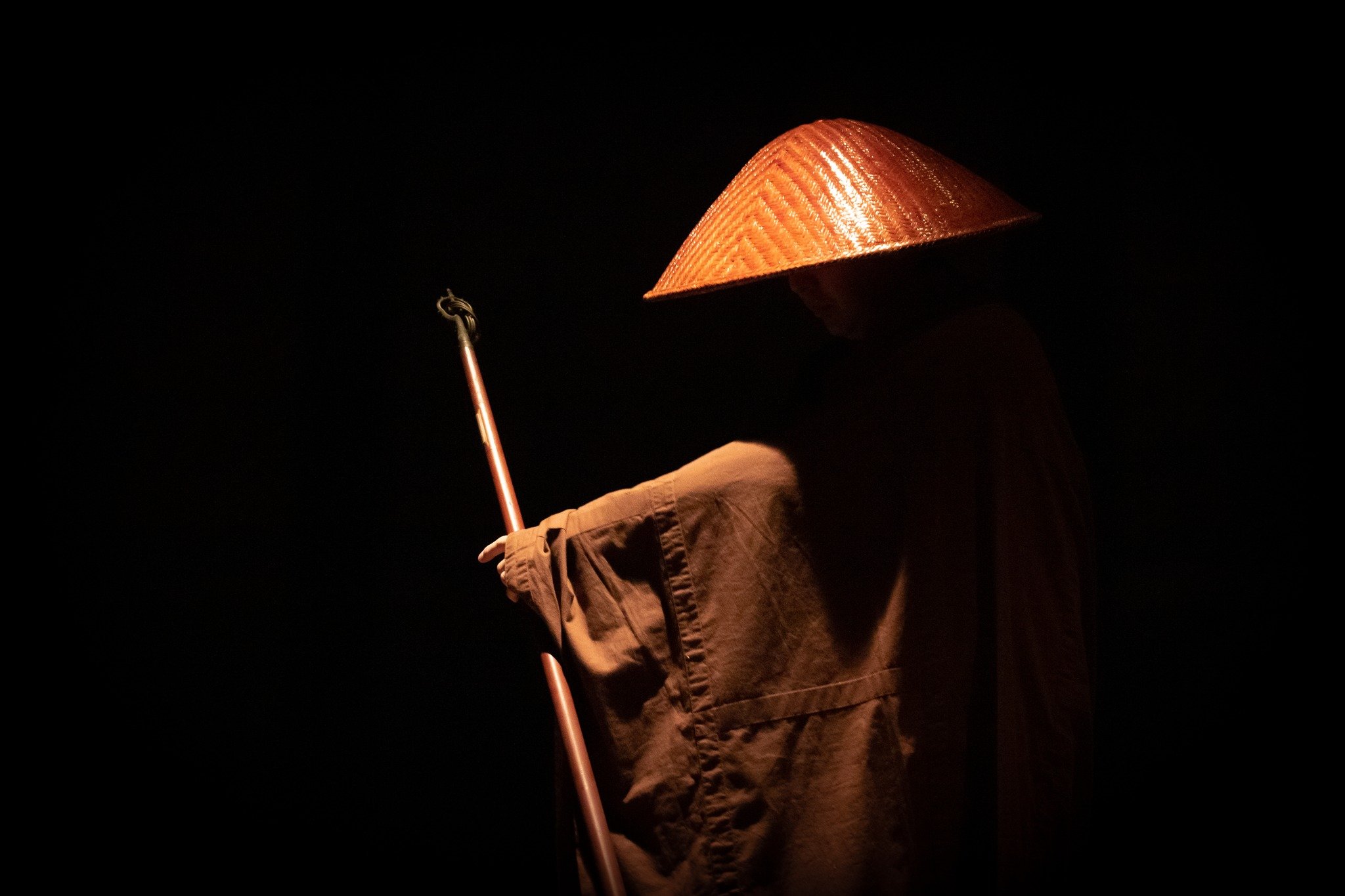
I wish to continue performing Aozukin.
Not because I simply want to introduce Japanese culture.
But because the questions it raises feel universal.
What does it mean to be human?
What is desire?
And how do we live with the oni that reside within us?
These questions belong to no single culture.
They remain with us.
Sources & Inspirations
青頭巾
人間の持つ、欲とは何だろうか。
わたしは、この上田秋成の描く<青頭巾>を演じることで、
人間の欲、そしてそれが変化した末の鬼の姿を観察してきた。
多くの人間は、鬼に出会うことなく、鬼を排除して、生きていくが
そのような途方もない狂気に出会った時に、
自分の中にそれがあったときに、
私たちは果たして、自分の持つ狂気と向き合うだけの、強さ、深さを持ち得るのだろうか。
⸻
私が青頭巾に強く惹かれるのは、この作品が単純な善悪の物語ではないからだ。
上田秋成は、人間の欲望や執着、狂気を描きながらも、それを裁く話ではない。
むしろ、人間が抱える醜さや弱さを、そのまま見つめ続けようとする。
その姿勢には、禅に通じる深い受容の精神を感じる。
⸻
青頭巾では、村人たちが
「どうやら鬼になってしまったらしい」
と語るだけで、物語は進んでいく。
しかし、本当に鬼がいたのかどうかは最後まで分からない。
鬼は実在したのかもしれないし、
あるいは人間たちの恐怖や不安が作り出した幻影だったのかもしれない。
⸻
私たち人間というもの、にんげんの社会という中では
理解できないものや受け入れたくないものに対して、
「悪」
「異常」
「敵」
という名前を与え、
鬼を作り出しているように見える。
⸻
鬼とは何だろうか。
欲望だろうか。
執着だろうか。
狂気だろうか。
⸻
物語の中で、熱心な修行僧は、その熱心さ、心のまっすぐさゆえに、
欲に囚われ、欲は執着に変わり、執着は狂気となって、やがて鬼に変容してしまう。
狂気に狂った僧は、救いを求めるが、鬼はただそこにあるものだと、最後には自己を受け入れることで、
消えていく(どうなったかも物語ではわからない)
多くの人間は、鬼に出会うことなく生きていく
あるいは、鬼を自分とは無関係なものとして遠ざけながら生きていく。
しかし青頭巾の物語が示しているのは、鬼とは決して人間の外側にある存在ではないということだ。
鬼とは決して人間の外側にある存在ではないということだ。
欲も、執着も、狂気も、
私たちの中に確かに存在している。
本当に恐ろしいのは、そうした人間の底の源流の一つである「欲」を
悪として排除してしまうことではないのだろうか。
欲は想像の源泉でもあり、他者を求める力でもあり、愛へと向かう力でもある。
欲があるから鬼になるのではない。
むしろ、欲を理解しないままに、悲しみから否定したり、
みないように(死を否定して坊主は死肉を啜ることとなる)したりした結果として、
異常なまでの執着や、狂気へと変化を遂げていく。
欲は私たちの中に、紛れもなく存在する。
欲を否定することでもなく
支配されることでもなく
それが自分の中にあると、認め続けること
わたしはそこに、この物語が示す、一つの強さを感じている。
⸻
<私はこの日本的な精神性に大きな魅力を感じている。
物事を単純なレイヤーで分けるのではなく、
矛盾や醜さを抱えたまま存在すること。
そして、その現実から目を背けずに生きること。
そこには責任と覚悟を伴った強さがある。
⸻
私たちが青頭巾で表現しようとしているのも、その感覚である。
僧侶の読経、三味線、語り、そして身体表現。
静と動。
言葉と身体。
欲望と解放。
それらの対話を通して、人間の内側にある変化を描こうとしている。>
⸻
私は、この作品をアメリカで上演してみたい。
それは日本文化を紹介したいからではない。
人間とは何か。
欲望とは何か。
そして私たちは、自分の中の鬼とどう向き合うのか。
その問いは国や文化を超えて共有できるものだと思うからだ。
⸻
